Wednesday, June 8, 2011

Group Living, Origins and History of the Domestic Cat


Domestic cats were evolved from the African wildcat Felis silvestirs libyca. The earliest domestication of cats was in  Egypt 4000 yrs ago.

From its sacred origin in ancient Egypt, the domestic cat, Felis silvestris catus, has spread over the globe as a household companion. When cats revert to the wild they are ubiquitous. The domestic cat has brought joyous companionship to people.  Cat populations can be female groups, at least loosely resembling those of lions, Panther leo, and those in which they live solitarily, generally in a territorial pattern typical of most wild felids. They have a capacity to live under constantly changing environments.


Recent genetic studies on cats throughout Italy strongly suggests that the domestic cat, European wildcat and African wildcat belong to the same polytypic species, felis silvestris. The European, felis s. silvestris and African, Felis s libyca, wildcats likely diverged from a common ancestor about 20000 years ago. The domestication of the African wildcat likely began about 40000 years ago in Egypt. Social organization in African wildcats is similar to Scottish wildcats. African wildcats had access to human refuse around which feral domestic cats gathered in colones, yet the wildcats appeared not to form colonies. It is possibly that a capacity to form large groups may have been produced by domestication. No behavior pattern has been recorded among free ranging domestic cats which has not also been reported in other felids, although association with people has made common resources such as shelter and clumped, predictable and abundant food.


Females of all feline species are group-living. Independent adults do not form permanent groups. In mammalian societeis, food and shelter are likely to be the limiting resources for females, while females are generally the limiting resource for males.  The probability that adult female felids will meet and stay together is strongly related to the likelihood of sharing food resources, commonly a kill.   When a rich food source is available, it is more than enough to feed several domestic cats.  Domestic Cats choose to sit together, and each individual favours the company of some over others. These associations are largely determined by the age, sex, social status and blood ties of the individuals involved.  Where once the image of the domestic cat was as one who walks alone, farm cats have complex social relationships. A female may lie in her nest of straw to birth kittens, then in close proximity of time, another cat may come to the nest, greet her and give birth, while the first cat serves as midwife, licks the new kittens, chews the membranes and bites through the umbilicus; they stroke and nurse each others' kittens and continue over several days. Communal breeding is common among farm cats.

Adult females associate with lineages which are the building blocks of feline societies. Large colonies embrace several lineages, each of which consists of related adult females and successive generations of their offspring. Females often interact within their lineage, and to a much lesser extent outside it. The overall parrtern within a lineage of cats is of a well integrated, amiable group. This is in marked contrast to the hostility with which members of such lineages generaly treat outsiders. Bigger lineages tend to occupy the best central area around the resource centre. Smaller lineages are spatially peripheral but have access to the central area to feed. Adult males do not seem to be socially tied to any lineage, but can be around the central resource centre, and those who are not., roam widely. Juveniles and kittens automatically belong socially to their mother's lineages. Offspring of central lineages access the resource centre easily and share lower mortality than those of peripheral lineages.


Domestic cats living on wild prey tend to be solitary and do not form groups, despite substantial home range overlap. In contrast, domestic cats with access to clumped food resources live in groups


Cats and People


Domestication and history of the cat

Origins of the cat
The family Felidea is of relatively recent evolutionary origins. Tee oldest fossil records of modern felids are only 3-5 million years old and molecular evidence suggests that all modern forms shared a common ancestor some 10-15 million years ago. Morphological and molecular studies of phylogenetic relationships among living felids show that the 38 extant species can be divided into 8 major phylogenetic lineages: th ocealot lineage, pantherine, caracal, puma, Asian leopard cat, bay cat, lynx, and domestic cat. Consisting of six species of small cats originating in the Mediterranean regions, it is thought to have diverged from the others around 8-10 million years ago.

It is difficualt to determine whether the domestic cat evolved from the silvestir or libycan line. Gene flow exists between domestic, feral and wild populations.

Bones or teeth provide archeological evidence which indicated a north African or western Aisan F. catus. European wildcats are extremely fierce and timid of people. African wildcats are docile, live and forage near human villages and settlement, capture rats and can adapt to huts. The etymological reason that the cat is likely from north Africa or western Asian origin is that the English word cat, the French chat, the German Katze, the Spanish gato and the fourth century Latin cattus, and the modern Arabic quttah all derive from the Nubian word kadiz, meaning a ca. The English diminutives puss and pussy and the Romanian word for cat pissica are thought to come from pasht, another name for Bastet, the Egyptian cat goddess. The tabby is named afer a special watered silk fabric, once manufactured in a quarter of Bahdad known as Attabiy.


Domestication is a gradual process, it is impossible to claim the exact time and place of cat domestication.  The cat was only fully domesticated during the last 150 years, but it is likely more accurate to view Felis catus as a species that has drifted unpredictably in and out of various states of domestication, semi domestication and feralness according to the ecological and cultural condition prevailing at different times and locations. Archaeological evidence from the Mediterranean island of Cyprus may provide a clue, where excavations of the earliest human settlement on Cuyory date from 6000 BCE. The remains of a cat's jawbone were found, the size of libyca species. No fossils of wildcats were found on the island before dating this, the only explanation is that cats arrived through human colonists, who captured and tamed wildcats long before the speciesawas domesticated.  There are known cat remains from Mostagedda in Egypt, dating from before 4000 BCE were with the bones in the grave of a man.

Since cats caught vermin, people would have encouraged cats to be around their home and granaries, establishing populations of urban cats that relied increasingly on humans for food and shelter. Humans may have been more active in domestication, carrying cats on ocean voyages. Petkeeping is widspread among subsistence gathering and hunting people throughout the world.  They would capture and take home wild animals, adopted by women. They are fed and care for, mourned when they die. The margay, ocelot and jaguar are species that they domesticate.


Predators, like wildcats, would forage the neighbourhood. Some would have nested and reared their young close to this supply of food, then the kittens would have been adopted.


The cat in Egypt
The first fully domesticated cat was in ancient Egypt. Small Egyptian amulets representing cats may be from 2300 BCE, the oldest pictorial representation in domestic context was in a 1950 BCE tomb of Baket III at Beni Hasa. In a pyramidal tomb of similar age, is a chapel containing bones of 17 cats with a row of little pots that may once have contained offerings of milk. From 1450 BCE onwards, images of cats in domestic settings became increasingly common in Theban tombs, it is likely that these were fully domesticated. They are shown eating fish, gnawing bones, playing with other animals.  Theban tombs of Nebamun 1450 BCE shows the cat helping the tomb owner and his family to hunt birds in marshes,  which shows that the Egyptians throught that an outing was incomplete without the participation of the family cat.

Cat domestication proceeded further in Egypt than elsewhere in the ancient world. Egyptians had an unusual affinity for animals in general. From the earliest dynasties onwards, animals played a particular role in their social and religious life.  A diversity of wild animals, including baboons, jackals, heron, ibises and cats were seen as the earthly representatives of gods and goddesses and many were the subjects of organised religious cults. This often involved keeping and caring for substantial captive populations in and around temples dedicated to the workshop of the deities. Species such as cats, who responded well to this treatment, bred in captivity and gave rise over many generations, to a  domestic strain more docile, sociable and tolerant of living at high densities. Their use as rodent catchers made them more valuable, though they would have been kept as cult subjects and household companions regardless of any practical or economic benefits.


Many gods and goddesses were part human, part animal  Most of these and their animal representatives originated in pre Dynastic times as tribal emblems or totems which were then integrated under the Egyptian State, to a complex pantheon along the lines of those in ancient Greece and Rome. Until the end of the third millenium BCE, Felis libyca appears to have had little to no reiligous significance to the ancient Egyptians. From 2000 to 1500 BCE, cats were represented on magic knives, incised ivory blades intended to avert bad luck, including nightmares, threat of poisonous snakes and scorpions. At the same time, the male cat began to be represented as one of the forms or manifestations of the sun god, Ra, and it was in the guise of  a tom cat that he was said to battle a monstrous serpent each night. The Egyptians were familiar with the sight of cats killing snakes, and they assumed that Ra would adopt the form of this animal when requiried to do likewise. The earliest representation of Ra in cat form, depicted animals that more resemble servals than cats, and it is likely that this coincided with the increasing familiarity as a domestic companion. One of the cat forms of Ra known as Miuty continued to be painted on the inside of coffins until the mid eighth century BCE, as a protective image.

During the New Kingdom 1540-1196 BCE cats also began to be associated with the goddess Hathor, and especially one of her manifestations known as Nebethetepet whose most  prominent characteristic was sexual energy. The natural sexual promiscuity of female cats was maybe linked to this. The well known association of domestic cats with the goddess Bastet did not become established until later, around the start of the first millenium BCE.

One explanation for the association between cats and the heavenly bodies involves the widely-believed legend that a cat's eye changes in shape and luminescence according to both the height of the sun in the sky, and the waxing and waning of the moon. The  Egyptian author, Horapollon, writing in the fourth century, noted that the pupils of the cat's eye changed according to the course of the sun and the time of day. The Roman writer, Plutarch, also mentioned the phenomenon, as did the English naturalist Edward Topsell, in his Historie of Foure-Footed Beastes (1607):

'The Egyptians have oberved in the eyes of a Cat, the encrease of the Moonlight, for with the Moone, they shine more fully with the ful, and more dimly in the change and wain, and the male Cat doth also vary his eyes with the sunne; for when the sunne ariseth, the apple (pupil) of his eye is long; towards noone it is round, and at evening it cannot be seene at all, but the whol eye shewth alike.'

Nineteenth century Chinese peasants shared this belief, and used cats' eyes as a means of telling time. The eye shine produced by cats' eyes at night intrigued many early writes. Many believed that cats could generate this light by storing light collected during the day. Many found it disconcerting. The glittering eyes of cats, when seen suddenly at night, 'can hardly be endured, for their flaming aspect'. -Topsell


The cult of Bastete

From the earliest period of Egyptian history, Bastet was the main deity of the city of Bubastis (now Tell Basta) in the southeastern part of the Nile Delta. She was a goddess without a real name, since Bastete means She of the City of Bast. The earliest portraits of Bastet, from 2800 BCE, depict her as a woman with the head of a lioness. On her forehead she bears the uraeus serpent symbol, and carries a long sceptre in one hand and the ankh sign in the other, Her attributes were sexual energy, fertility and childbearing and nurturing. She was associated with other local deiiteis, Memphis, Heliopols and Heracleopolis. She was associated en route, and through a process of local assimilation, with other important female deities, Mut, Pakhet and Sekhmet, goddesses who are often represented as lioness headed,  as well as Hathor, Neith and Isis. Bastet and Sekhmet were paired as complimentary opposites from 1850 BCE,  and eventually came to be regarded as different aspects of the same goddess. Bastet represented the protective, nurturing side, and Sekhmet the dangerous and threatening one. Hathor, Mut, Isis and Bastet were referred to as daughter or eye of Ra.

It is unknown when domestic cats were first were regarded as manifesttions of Bastet, but it is likely during the Twenty second Dynasty 945-715 BCE. Information about the cult of Bastet and her temple is gathered from the writing of the Greek historian, Herodotus, who visited Bubastis aorund 450 BC during the height of the cult. He equated her with the Greek goddess, Artemis, and described her temple.  It is likely that a sacred cattery or breeding colony of cats adjoined the temple. The job of cat  keeper was an hereditary position and stict rules governed the care and feeding of the captive manifestations of the deity.  The annual festival of Bastet, during April and May, was the largest in Egypt, with ovr 700000 people attending, having performed a a pilgrimage by water along the Nile. The licentious atmosphere was likely what made it so popular; people would play rattles, flutes, sing, clap, dance and drink a lot of wine.


 He was the first to record the now well known phenomenon of male infanticide in cats, in order to make the female prepared to mate  The status of cats during this period was roughly that of cows in present day India. Many people had house cats,  and the death of one had the family mourning, shaving their eyebrows as a mark of respect. Those who could afford to had their cats embalmed and buried in special cat cemeteries, vast underground chambers containing the mummified or cremated remains of hundreds of thousands of them. Cat cemeteries have been unearthed at Bubastis, Beni Hasan and Saqqara, a clean indication of the spread of the cult of Bastet. Large numbers of small bronze statuettes of cats were deposited in the sacred burial ground.  The act of dedicating one of the votive statuettes to the temple assured the giver a permanent place beside the goddess. One cemetery contained the remains of 80,000 cats.  Cats were a protected species, causing the death of one, even by accient, was a capital offense, thus anyone encountering a dead cat fled immediately,  Radiographic analysis of cat mummies has revealed that most of them were killed by strangulation before 2 years of age, in order to feed the demand for dead cats to mummify as votive offerings.


From Africa
The Egyptians generally restricted the spread of cats to other countries by making their export illegal. They even sent special agents out to neighbouring parts of the Mediteranean to buy the cats that had been illegally smuggled abroad. Cats eventually spread to other areas although, initially progress was slow. The Indus valley Harppan civilization 2100-2500 BCE provides early evidence of urban cats. Bone remains and the pawprint of a cat being chased by a dog are preserved in mud brick . It is unknown if these were from Egypt or the results of local domestication. An ivory statuette of a cat, 1700 BCE, was found in Palestine. It is likely that Egyptian merchants lived there and brought their cats. A fresco and a terracotta head of a cat from 1500-1100 BCE are from late Minoan Crete, another area which likely traded with Egypt. It does not appear to have reached Greece until later. The earliest representation of the animals from Greece is on a marble block from 500 BCE. Cats were not common at this time and were kept as curiosities rather than for any practical purpose. To get rid of rodents, Greeks and Romans used domestic polecats or ferrets in preference to cats. During the fifth century BCE, the Gerreks introduced cats to southern Italy. The cat does not appear to have been popular, except as an unusual and exotic pet. Neopolitan mosaics from the first century BCE, show a cat catching a bird, but there are few literary or artistic depicitions of cats. The Romans didn't understand the cat's vermin killing abilities unitl the fourth century when Palladium recommended the use of cats, rather than the traditional ferret, for curbing moles in artichoke beds. Cats were slow to reach the Far East. They arrived in China sometime after 200 BCE.
All of the early cats had the wild type, striped or spotted tabby coat, and many feral cats around the Mediterranean retain this ancestral libyca appearance.


The Romans likely introduced cats to northern Europe and other outposts of their Empre. They were already present in Britain by the mid fourth century and their remains have been found in numerous Roman villas and settlements in southern England. In Silchester, an important Roman site, archeologists found a set of clay tiles bearing the impression of cat pawprints. By the tenth century, they appear to have been widespread, if not common, throughout most of Europe and Asia. The sex linked orange color ginger, ginger and white, calico and tortoiseshell appear to have originated in Asia Minor, and to have been transported, possibly in Viking longships, to Brittany,  all over Britain and parts of Scandinavia. The English blotched tabby seems to have spread from a corridor through France along the valley of the rivers Seine and Rhone. For centuries these rivers have formed part of an important inland barge route between the Channel Ports and the Mediterranaean.


Changes in attitude
The gradual eradication of the pagan gods and goddesses, and the rise and spread of Christianity, produced a dramatic change in attitudes to cats throughout Europe. From being benevolent symbols of female fertility, sexuality and motherhood, they became, instead, the antithesis: evil demons, agents of the devil, and the  companions of witches.

It is unclear what caused this change in the perception, although political forces played a role. In order to consolidate its power, the medievel Church showed extreme ruthlessness in repressing unorthodox beliefs, and ridding all traces of earlier pre-Christian religion. Its symbolic links with earlier fertility cults, the cat was caught up in the wave of religious persecution.


Between the twelfth and fourteenth centuries, nearly all the major heretical sects-Templar, Walendian, Cathars-were accused of worshipping the Devil in the form of a large black cat. Many modern accounts described how their rituals involved acts of ceremonial gratitude toward huge cats which where supossedly kissed on the anus. Alan of Lille even claimed to derive the term Cathar from the Old Latin word for cat, cattus, which was untrue. Under Christianity, cats also come to be clsoely associated with witchcraft, although the nature of this varied from place to place.  Like their heretical predecessors, witches were said to fly to their gatherings or sabbats sometimes on the back of demons disguised as giant cats. The devil also displayed a strong preference for appearing to his disciples in the form of a monstrous cat, supposedly. At the level of popular or folk culture, it was more common, in northern Europe, for people to view cats and hares as the preferred forms adopted by witches when engaging in acts of malice. In 1211, Gervase of Tiklbury attested from experience to the existence of women 'prowling about at night in the form of cats' who, when wounded, 'bear on their bodies in the numerical place the wounds inflicted upon the cat, and if a limb has been lopped off the animal, they have lost a corresponding member'. In 1424 a shapeshifting witch named Finicella was burned in Rome for allegedly trying to kill a child when she visited in the form of a cat. The child's father drove the cat away, wounding it with a knife. Later she was found to have a similar wounds on the same part of her body. Stories of this type were very widespead in medieval and post medieval witchcraft folklore, and they provide an interesting connection with another well known diabolical role of the cat, that of the archetypal witch's familiar.

The familiar or imp was a demonic companion who the witch dispatched to carry out her evil deeds in return for protection and food. One child claimed his mother was a witch, citing Tyttnety, a little grey cat and Jacke,  black like a cat, as her helpers. People claimed that witches turned into cats to make them and their children ill. Cats predominated in the role of witch's familiar. They continued to do so throughout the entire period of witch trials in England, and have since become the ubiquitous Hallowe'en icon.

As demons incarnate, these animal familiars had a degree of autonomy. The cat familar and cat as transformed witch were basically the same, in several cases, witches were reported to suffer parallel injuries when their familiars were wounded, and sometimes the prosecution witnesses believed that the familiar was the witch transmogrified,  witnesses attested to being visited and tormented by the cats, one had the face of the witch.


Some of the hostility toward cats that emerged during this period may have had a medical basis. Witchcraft folklore is rich with tales of witches taking on the form of cats in order to sneak into people's houses to smother them in their sleep. In one of the earliest references to allergic asthma, Topsell, in 1607, stated: 'thebreath and favour of Cats consume the radical humours and destroy the lungs, and therefore they which keep their Cats with them in their beds have the air corrupted, and fall into several Hecticks and consumptions.' As recently as the 1920's local superstitions held that it was unsafe for a cat to sleep in a child's cot or bed due to the danger of suffocation, and a recent survey in the US found that respiratory allergies are one of the most common reasons given by people for giving cats but not dogs, to animal shelters.
With such a wealth of negaive associations, it is not surprising that cats became objects of widespread persecution throughout Europe during the Middle Ages and the early modern period.

By associating cats with the devil and misfortune, the mediveal Church seems to have provided the superstitious masses of Europe with a universal scapegoat, something to blame and punish for all of life's numerous dangers and hardships.

A stong element of misogyny also underpinned this intense hatred toward cats. Medieval and early modern Christianity was dominated by an all powerful male priesthood who held very ambivalent attitudes toward women. Medieval clerics accepted Aristotle's evaluation of the female cat as a particularly lecherous animal that actively manipulated males on to sexual congress. Thus a strong metaphorical connection was established between cats and the more threatening aspects of female sexuality.  The natural behavior of cats reinforced the association. Female cats, especially in oestrus, solicit physical contact and enjoy being stroked and caressed but they are also notoriously coy and unpredictable, demanding affection at one moment, scratching or running away the next. Sexually, the female cat is very promiscuous, unashamedly invinting attentions of several males. She is also a back biter, often turning around and attacking her partner right after mating.

For the ancient Egyptians, these normal feline atributes, with maternal devotion, were admired and celebrated. For the sexually suppressed cleric of medieval and early modern Europe, however, they seem to have inspired  horror and disgust.


Europe was not the only region to draw negative links between cats and women. Malevolent, spectral cats were a common element of Oriental folklore, and in Japan popular legends were of monstrous vampire cats who assume the form of women in order to suck the blood and vitality from unsuspecting men. The Japanese applied the work cat to Geishas on the ground that both possessed the ability to bewitch men with their charms. According to superstition, the tail was the source of the cat's supernatural powers. This belief may also explain the origin of the genetically unique, bob tailed cats of Japan.

The cat's ambivalent relationship with humans is another possible clue to its victimization. The dog and cat are two of the few domestic species that do not need to be caged, fenced in or tethered  in order to maintain its links with humans. Cats tend to display a degree of independence which is unlike dogs, and which makes them inclined to wander at will and indulge in noisy sexual forays, especially during darkness. Cats lead a double life-half domestic, half wild, part culture, part nature, and maybe this non-conforming to human (male) standard of proper conduct is part of what led to their subsequent harassment.


By exploiting the comfort of domestic life while simultaneously enjoying the pleasue of a wild night, the cat became the object of official condemnation and persecution, by challenging the convenient dualistic world view.  The cat was a symbol of humanity's baser qualities. The image of the cat remains damaged, by its older unruly reputation.  In the majority of Islamic countries, attributes of dogs and cats are reversed; cats are tolerated and to some extent, admired.


The domestic cat has now spread to virtually every part of the inhabited world. Across most of Europe and North America it has now overtaken the dog as the most popular companion animal. Very recently, the cat was despised and distrusted for its lack of deference and its failure to acknowledge human domination and superiority. It has been negatively portrayed as the chosen ally of womankind.  In nineteenth century Pais and elsewhere in Europe, cats were associated with artisans and intellectuals, by virtue of their independence, and lack of adherence and obedience to social rule and conventions. This represented a marked turning point in attitudes toward cats, and proceeded their widepread adoption into bourgeous society as fashionable middle class companions.  Many people still regard the sudden appearance of a cat as a sign of bad luck, and others fear or dislike them, perceiving them as avoidant and untrustworthy,. The cat's long standing association with women and female sexuality is still implied by the slang, 'cat house', 'pussy'. Hopefully the legacy of negative attitudes toward cats will continue to disappear, as people learn to accept the benefits of living with this clean, affectionate and very companionable species. 


Cats have been valued since ancient times for their rodent catching abilites, and they have acquired religious and symbolic importance in many societies. Attitudes toward them as symbols, have ranged from reverence to abhorrence. In ancient Egypt, cats were worshipped and protected as representatives of Bastet,  goddess of fertility and motherhood. In medieval and early modern Europe, on the contrary, they were a metaphor for female sexual depravity and social unruliness and were persecuted and despised.  In symbolic terms, cats still appear to evoke a certain ambivalence of feeling in many Western countries, though, within the last 10-20 years, they have finally surpassed the dog as the world's most popular companion animal.


ALL TEXT AND IMAGES COPYRIGHT Textual and image content of site. Copyright © 2011 Amanda Dainow. All rights reserved. All text and images on this site are the property of Amanda Dainow and are protected by Canadian and other foreign copyright and trademark laws. The text and images of this website may not be copied, translated or distributed in any manner (electronic, web or printed) without the prior written consent of Amanda Dainow. 

Tuesday, June 7, 2011

The Mythology and Healing Powers of Dogs

Dogs have been with us a long time, estimates are as long ago as tems of thousands of years. They have provided protections of flocks, babysitting (pit bulls fulfilled this role only last century), saviors, healers, companions and many, many other roles. Dogs can provide care for people with epilepsy, by warning the person of an impending attack and guiding him/her to a safe place where he/she will not be hurt during a seizure. They have been aiding the blind for decades, as well as others with a plethora of special needs. They can pick up and bring a phone, open and close doors, turn lights off and on, guide a person to their destination, and do just about anything their person requires of them. 

Every year, millions upon millions of adoptable animals are euthanized, while many others require the patience, care and training to be rehabilitated and re-homed. So please, if you are considering a canid companion for yourself and your family, rescue an animal from a shelter. Mixed breed dogs are less prone to genetic health and structural problems, and provide companionship that is equal to that of purebred dogs.


 Basset Hounds

Basset hounds have a great sense of humourthey appear to like and sometimes give a good practical joke. This can be tripping on their own ears to get a laugh, dancing on clackety-claws across a floor, or chasing cows, which they do not actually disliike or like.
Truly, laughter is the best medicine.

 There is a myth that good hounds, or heavenly ones, may provide their person with the power to heal (not heel!).

Boston Terrier

There is a myth of psychic power that seems to have developed around the Boston terrier. Jospeh W. Wylder, in Psychic Pets, has  written of a remarkable terrier named Missie, "...one of the widest known and best documented psychic pets of recent times."  The London Daily Mail accliamed Missie as one of our generation's most prominent prophets. What did she do to earn this reputation? She developed a system where she could give numerical information to people that was inevitably correct. She is said to have been able to tell how many coins someone carried in a purse, and she would give this information by an appropriate number of barks. Her real genius, though, was for prediction, which she did by anwering questions of a numerical kind by barking her answer. Many skeptics tried to denounce her pronouncemnts, but no one could prove her wrong. She even knew the time of her own death, and she announced it before she died. Often people with these dogs will report they have a special grasp of numbers, times, and schedules. While all dogs can be said to have this gift, this breed may have more of it than any other.


King Charles Spaniel
The King Charles spaniel remains outside classification by having a selfless temperament, an ego less disposition,a fervent desire to aid the afflictions of people, and a cuteness all his own.  A comforter of women, lapdog, cozier and comforter, another practical purpose they have is drawing fleas and other tiny vermin away from their people. They hid under petticoats, to lie silky-eared and soulful on the laps of the aristocracy.

A prescription once recommended that the queen of England keep a Comforte Dog on her lap to treat a cold. In the days of drafty castles and chilly carriages, and through the uncertainty of the plague years, the cavalier was the lap watcher of monarch and lady. Pythagoras once explained that small dogs of the spaniel type were able to store the breath of a dying person and carry it with them, keeping the spirit alive. They also offered lick therapy, the tongue being a medicine. The French believed that a dog's wet tongue could cure ulcers. The Greeks thought that the dog could protect them not only from terrestiral enemies, but from evil spirits as well. If a person felt the onset of these spirits, he carried a dog with him at all times. The belief that a dog's presence would keep evil at bay is with us today, as dogs are often used in care centres of all kinds, especially with the elderly and children.

Small dogs, due to their portability, were granted much more than medicinal powers. They became spiritual advisers, silent travel companions  resting in the crook of an arm, the curve of a lap, and beside their beloved's head, on the dent of a pillow. Thus to have a dog beside you if you were feeling unwell was to have  a talisman against harm, a physician/shaman/priest/best friend who would never leave your side, no matter the condition-finanical or physical-you were in.  When Charlie snuggles, so does the heart. It is an old medicine for melancholy, but it still seems to work.  The curative powers of this small dog have been known for a long time.


The chuhuahua is used as a hot water bottle.


Daschund

In keeping with their ancient tradition, they are excellent trackers, diggers, night watchers and nurses, devoted to people.  Recently, a daschund helped a lost ten year old  with Down's syndrome return home. The boy was playing in his yard when he saw two stray dogs, one of them a daschund and the other a heeler, trot past him. He followed them deep into a forest, where, as temperatures dropped into single digits, the two dogs stayed by the boy's side, sheltering him from the wind. For three days they kept him  alive, but it was the dachsy's resonant bark that led a man on horseback to the kid, whose only injury was frost bitten toes. The dogs were called 'God's angels' by the mother, who has rewarded the dachsund with a permanent home.

Dalmation
 The Dalmation was a sentinel in war, a draft dog, shepherd, ratter, firehouse mascot, retriever, pointer, rescue dog.  The dal appears in Tuscany on a triptych showing St Domino blessing a chalice. The dog indicated the saint's power over the disease of hydrophobia, or rabies. This is associated with the mythology of dogs' breath being sacred and dog saliva being curative.  The dalmation has dashed in to flames, the firefighter's savior.


Dingo

Aboriginal people in the American West have a special fondness for dingoes, even letting them sleep with their children and act as their guardians.  Developing countries have alliances between women and dogs.

Terriers
Each hamlet in the British Isles during the eighteenth century had a favorite terrier to kill rodents and burrowing animals of the community.

German Shepherd
 As one German Shepherd police dog trainer said, "He wants to experience life.... he wants to know the thing itself. The dog is much superior to the person." German shepherds are intelligent, resourceful and have made remarkable contributions as guard dogs, sheep dogs, companions, family dogs, guide dogs, rescue dogs, and army,  fire and police dogs.


Dog Myths

Dog myths delve into the realm of animal intelligence in comic and serious ways, but alwyas, they assume that all people know that dogs began on earth by having a close relationship with the elements, the deities of wind, fire and water, while people were just coming to know them. Myths tell us that Dog had teeth before people. They explain that Dog knew Fire, but person hasn't been blessed with knowledge of it yet. More importantly, the old myths imply that Dog's knowledge of God preceded person's. There are many truths taught by the cultural myths of indigenous people around the world. Dog is a ranked citizen on the plane of existence, he is often a  representative of First person. Dogs greatly surpass humans in the area of telepathy, or body reading, and can read us like an open book,  though we have a harder time reading dogs. You can't lie to an animal, they instantly break down the barriers and facades, and see how we truly feel, who we really are.


Dogs, kindly characters that they are, usually have the grace to keep silent about what they know, while clearly humans are incapable of such. They can see how they stand in relation to us, and we to them, as their pack leader.  They know us as we do not know them.


Golden Retriever
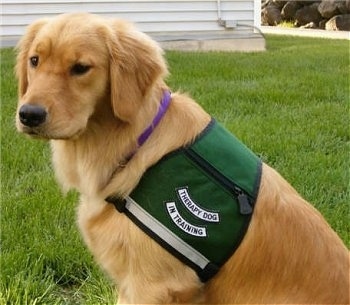
 The golden retrieber is one of the most popular dogs in guiding the blind and helping the physically challenged.  They have a preference for good deeds, problem solving. They love offering someone a helping paw, even if it causes a distressing moment for themselves. They are unselfish and unrestrained in their love of companionship and their offering of guidance.  They will go out of their way to aid a human in distress. There are myths of ghost dogs coming back to save loved ones from burning bulldings and the like, some of which star goldens.


Dog Star, Dog Days
To a traveler upon the trail, the Dog Star was a lantern, a beacon against the darkness that surrounded them. Mohammed called God the Lord of the Dog Star. Some ancient civilizations-Greek and Roman, for example-saw the coming of the star as the onset of madness, the dawning of dog days, a term we still use today. What this meant was that the Dog Star, which came during the hot months of July and August, was bound to bring more heat. This, of course, could be destructive to crops. The Dog Star is a myth, giving a heavenly spirit to the earthy body. Within each of the heros and prophets, there resides a dog, who, whether heavenly or hellish, kindly or crazy, keeps an eye out for humanity.


Lhasa apso

The Lhasa apso is often identified with Buddhism and the Dalai Lama. They may have followed the old rounds of the Buddhist monks, following the Bodhidharma, the Patriarch who brought holiness out of a cave in India and it to the world. In the myth of the dog, they watched over an emperor or a Lama. In Peking, there were the Pekingese; in mountains of Tibet, Lhasa apso. Males were given as gifts by the Dalai Lama; sacred animals had a spiritual identity with the lion of the sakyas, or the Buddha himself. They are trained to turn the prayer wheel for the Lamas. They are known as Prayer Dogs. Chysanthemum Dog is another nickname. Apso seng kye, means barking lion sentinel dog. In England, he was known as the Talisman Dog, in view of his brining of good luck to any and all who may come to have him. in their home. Some Tibetans beleive him to be a reincarnated lama, who has not yet ascended to heaven. Thus, a spiritually potent being, and a lucky dog.

She is at home in the monasteries in the remotest mountain retreats of Tibet with lamas.  Dogs in the old Buddhist tales are in a constant state of satory, or watchfulness; humans can attain this themselves, but it is difficult and not an easy path for the average person. A dog is a guide to satory, with their eyes and ears, he is in a constant awakened attention to those around him; he is what the Buddhists sometimes call a realized being. Lhasa were used to guard the inner court of the Dalai Lama. When he looks at a person, he immediately knows whether he looking at a friend or a foe. They have acute hearing, quick reflexes.


Maltese
The name comforter derives from the dog's use as a hot water bottle and as an extractor of pain and illness drawn out of and away from the stomach.


Newfoundlander
They have been doing sea rescues, horse guarding and have been ships' dogs and heroes for centuries.  A famous Newf, during a raging winter storm, saved one hundred people off the coast of Newfoundland. He braved the white capped waves and blizzardlike winds to fetch a lifeline back to shore so that the ship could be stabilized.


Pekingese
There is a myth that the Pekingese were at Buddha's heels. In Japan, the mythhs of the Buddha were further refined. The Lion of Buddha became the Dog of Fo. In native art, this dog was represented as a Pekingese. An eleventh-century Japanese painting shows the entry of Buddha into Nrivana. Beside his praying discipeles, there is a sacred Lion Dog. He is shown lying on his back, feet in air-the familiar pose of the Pekingese.  Kubla Khan, grandson of the greatest warrior monarch of all time, Genghis Kahn, knew the symbolism of the Lion Dog. His thirteenth-century court, heavily influenced by Lamaist Buddhism, contained both lions and dogs. The lions, apparently lay in attitudes of courtly feline apprehension, while thee tiny companions, the little Lion Dog Pekingese, played fearlessly around their curved claws.

In 1861 during the invasion of Pekings, British and French officers came upon the body of the imperial princess, who had gathered about her five sacred lion dogs before her death. These ancestral guardians, whose distant relatives had once guarded her ancestors, were so small and yet so noble as they kept their loyal, circular watch.


Spitz Dogs
Spitz dogs were part of the religions in the North. In the North American indigenous tradition,women treat pups the same as their own children, suckling them. This was not unusual to Northern people; in Italy it was common in the eighteenth century for women to suckle fox kits.

The early settlers in Canada were greeted by Spitz dogs who had a large amount of wolf blood. Such pack animals were described as pointed faced dogs and were considered fox dogs, though it was clear they were really domesticated wolves. They howled like wolves and were unable to bark. They were treated as family members and often seen walking into tents at night and eating out of the peoples' porridge bowls, as if used to eating like people.


Lapplanders and Dogs
The Native Laplanders are the Reindeer people, Europeans considered them to be wizards and sages, whose shamanic power came from the spirit of the dog. A household spririt always watched over the hearth of the Russion Lapp families, they offered her food at each meal. Lapp dogs guarded house, family and reindeer herds. They have musical signals, melodies for their dogs. Fox-dog myths are as numerous as the customs which accompany them. The Lapps believe that they were descendents of the dog clan, each individual of the clan had his/her own dog spirit.


Toy Poodles
 Toy poodles are delicate diggers of truffles in the damp, fragrant forests of France.


Pugs
   Pugs were most skilled in the healing arts, skilled at pulling out fevers, relieving headaches and drawing off serious illnesses, atrracting the sickness unto themselves. Today, experts agree that the medicinal aspect of these dogs has something to do with the common comfort and empathy they offer, but it's also been shown that they can reduce the symptoms of high blood pressure and stress, as can any dog, just being there.


Finely bred pugs were suckled and treated and mothered as finely bred children.

It's the medicine we seem to need, if nothing else pleases, at least we, as frustrated humans, can be pleased by a dog. Since the earliest times, the pug and all dogs have always tried to please us.


Rhodesian Ridgeback

They are excellent watchdogs, especially on the prowl at night. They were on African farms to protect the farmer's sleeping animals. The love of dogs stands above parental care among the Zulus of South Africa.


Rottweiler

She is a companion whose passion is to protect the property and person of her person. An outstanding recent example of the rotty's dedication as a guardian appeared in the Associated Press news story of the dog called Samantha. This legendary rotty saved the life of three year old Blake Weaver by remaining at his side for twenty hours. Barefoot, wearing only shorts and a T shirt, Blake had strayed off into the deep woods of the Ocala National Forest of Central Florida. During the cold January night, Samantha, the family rotty, stayed close and kept him warm. Through the night, as a wind chill factor brought a 30 degree temperature, she stayed on guard and blanketed the boy. The next day, Samantha led Blake to the dirt road where four hundred searchers were plying the woods, searching for him. He was found unharmed, owing, the physcians claimed, to the dog's care. Today, Samantha the rotty is an honorary County Deputy.


St. Bernard

St. Bernard: guardian, companion and search and rescue dog. Right from the start, she naturally took to the snows and demonstrated a desire to seek out avalanche victims. Case histories from the earliest times show that this amazing dog, with little or no training, went to her work with professional ease and rugged determination. The result, is 300 years of rescue services in the Alpine mountains, and elsewhere, saving thousands of human lives.

The St. Bernard's capacity for adoration is even larger than the dog herself.


Saluki
In Mohammedanism it is believed that a mysterious power inhabits certain beings and things, this gentle force that flows from the natural world is present within the silky saluki, and is known as baraka. The swift el hor, saluki. The dog's telescopic sight is the gift of Allah, and so is his fleetness of foot. Both are said to have baraka. He can outrun an Arabian gazelle, one of the fastest creatures on earth;  he is driven by the force of baraka.  One of the myths around the dog is that he/she is the emissary between the world of life and death.  Mataphorically, to be eaten by one so holy as a bleesed dog is to be reborn, to enter the force of baraka, to be one with Allah.


Samoyed
This dog shepherds reindeer and guards herds against wild animals in Europe, Asia and Siberia. What the Natives of the Siberian steppes have always known is that this dog is very loving and considerate of humans. European dog myths include the white dog of death-the sight preceded the death of a family member.  In some parts of Wales the vision of  a white dog means that a dying person or someone soon to die unexpectedly, will be saved from hell and will go to heaven.


Schnauzer
The giant schnauzer is a cattle driver, household guardian, police dog, companion dog in Europe and America. All three types of schnauzer make excellent watchdogs and ratters.

Shar-pei
  Chinese provinces still celebrate the old myth of Pan Hu, a Shar-pei god. He is worshiped as an ancestral being at the New Year and at other sacred seasons.

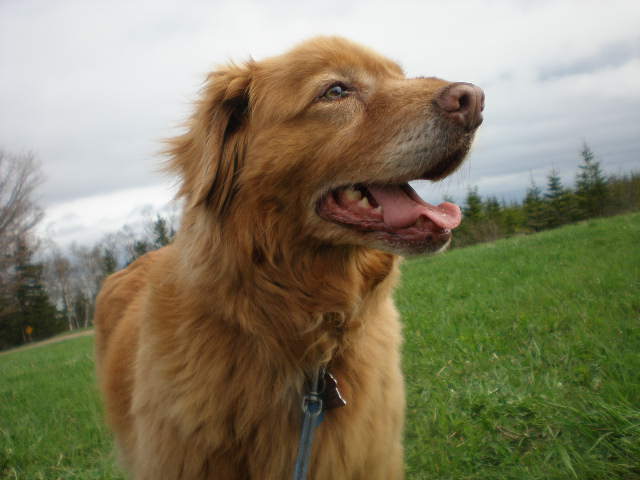
Brittany, A beautiful rescued Nova Scotia ducktoller

Dogs and Rescue
Dogs have inner alarms which go off, saving their families before they are aware of fires.  We have all heard stories of dogs who have saved people from fires. Once bred to ward off evil spirits with a bark, smoke in many Chinese myths was not only associated with fire, but the familar of dangerous ghosts.

Rescued dogs at CAPS, above, a mixed breed, below, a husky who I walked.


Huskies
The most famous race of 1910 was the Serum Run, in which huskies carried life saving serum through minus 50 degree gales to where there was a dyptheria epidemic.  The most common myth of the North is that of the Dog Ancestor. The Siberian Mongols believe that their ancestor was a dog, or was nourished by one, and this corresponds to the fact that some Inuit women suckle puppies as if they were their own. The Bruiats, another Siberian people, claim that long ago all men were born as dogs,  while all females were born as women.  Just as life came from dogs, it also is said that 'life went to the dogs' meaning that these wonderful creatures were credited with the gift of life and death.


The Yenisei Ostiaks of Siberia tell how they found their first 'dead' and when the Creator heard the peoples' wail, he sent Dog to comfort them and show them how to turn death into life. In many such tales, though, Dog is proven to be quite forgetful, and in their care he didn't remember his real purpose. Instead of teaching resurrection, he taught the art of earth burial, giving death a ceremonial existence and rationale.

A Siberian Shamans' song celebrates Dog's funny memory,. Here is a great animals who cannot forget what he once did, or what he is, or what life and death really mean. The Shaman, seeing Dog look upon the grave of a man, sings out 'Oh, look at this dog. He stands crosswise and looks back.' So do we, regarding our long and prosperous history and mythology of the Dog.

ALL TEXT AND IMAGES COPYRIGHT Textual and image content of site. Copyright © 2011 Amanda Dainow. All rights reserved. All text and images on this site are the property of Amanda Dainow and are protected by Canadian and other foreign copyright and trademark laws. The text and images of this website may not be copied, translated or distributed in any manner (electronic, web or printed) without the prior written consent of Amanda Dainow.  

Receive Reiki Healing

Receive Reiki Healing
   Level I Reiki
    
August 12-14, 2011
  Reiki Master, Tashi Treechild will visit Singing Nettles Clinic

 She was initiated by Phyllis Lei    Furumoto in 1985 and has been teaching for over 25 years
  Learn to heal yourself and your loved ones
     
Cost:$150
   Please refrain from using any scented chemical products, including laundry soap, shampoo and deodorant.

To register: contact Amanda
      amanda@singingnettles.ca
      902-538-3662

      Questions: Treechild
      902-624-0920


ALL TEXT AND IMAGES COPYRIGHT Textual and image content of site. Copyright © 2011 Amanda Dainow. All rights reserved. All text and images on this site are the property of Amanda Dainow and are protected by Canadian and other foreign copyright and trademark laws. The text and images of this website may not be copied, translated or distributed in any manner (electronic, web or printed) without the prior written consent of Amanda Dainow. 

Wednesday, June 1, 2011

Domestic Cats (Featuring the cats at CAPS!)

Social Life

The Signalling repertoire of the cat and its wild relatives

The scent signals of domestic cats are products of their acute sense of smell, which could have developed primarily to detect food, and from their origin as territorial animals which needed to communicate with neighbors that they may rarely encounter face to face. Communication is said to happen when one animal responds to the signals sent by another.  In many cases there is no reason to believe that both animals agree about the message being transferred; signallers often attempt to manipulate the behavior of recipients to their own advantage, while recipients attempt to mind-read these descriptions. The influence of domestication on signalling adds another layer to the explanation of why signals take the form they do. For the cat, the ancestral species Felis silvestris libyca is believed to be exclusively territorial, and so its signalling vocabulary must have changed as it evolved to live at high densities and become sociable. When individual animals live close togehter, and benefit by cooperating, they must have the ability to resolve conflicts without resorting to physical violence, especially when both parties are as well armed as a cat.

Communication between domestic cats

Olfactory communication

The ancestral species of the domestic cat was likely exclusively territorial, as are most of the smaller species in the Felidae. Since widely spaced animals rarely encounter one another face to face, they tend to communicate by scent marks, which allow a delay of several hours or days between the deposition of the signal and its reception. For well-armed carnivores, there is also the advantage that potentially dangerous encounters with rivals can be avoided by the use of olfactory signals, both those deposited on the layers of medium and those carried directly from the body surface by air current, The potential disadvantage of relying on scent signals is lack of control, both in direction of the message, which depends on the wind, and of who receives it, since a scent-mark cannot be turned off at will, both lead to potential revealing of the information that the scent contains. Despite these problems, members of the Carnivora rely extensively on scent for communication.

Many domestic cats live at a densities several times higher than their wild counterparts, and it is thus possible that their scent communication has been changed during the course of domestication. Cats who live in groups can potentially not only exchange information through scents,  but also exchange the scents themselves to product colony or group specific odors. Comparisons with other species suggest that the domestic cat should have a complex and adaptable repertoire of scent signals, so it is no surprise that  several sources of scent have been found, though their functions in comminication are unknown.


Urine

Cats can adopt 2 distinctly different postures for urination, indicating that at least one has some use in signalling. Kittens, juveniles and adult females usually squat to urinate, then usually cover the urine with soil or litter. Although this can be interpreted as an attempt to hide urine and the information that its odor contains. Such deposits are sniffed by other cats if encountered. The duration of sniffing tends to increase with the unfamiliarity of the depositor, suggesting that the sniffer is responding to and gathering information from the odor. This may only be a common occurrence where cats are living in high densities; trying to hide it may be effective in widely spaced territories.

Deliberate scent marking with urine is done by spraying, in which the cat backs up to a vertical surface, and urinates backwards, usually while quivering its tail. While mature males are the most frequent sprayers, adult females do spray. In closed or high density colonies there may be some suppression of spraying in females and younger males, resulting in most spray-marks being produced by a small number of 'dominant' males. Spraying by tom cats is increased by the closeness of oestrus females, resulting in an annual peak in the UK in February/March.

The odor of sprayed urine is pungent, so it may carry other secretions, possibly from the perputial or anal glands. The anal gland secretion, which is voided by very frightened cats, has a strong odor, but this is not, to the human nose, similar to that of sprayed urine. The odor of sprayed urine increases after deposition and is likely largely due to the microbial and oxidative degradation of the two unusual amino acids. The male can excrete large amounts of felinine, whereas females produce less, thus less pungent sprayed urine. This excretion may have a significant effect on the sulphur containing amino acid requirements of the male; it is possible that the amount of felinine in urine, and hence the strength of the odor, is a reflection on the success of the male in obtaining high quality food, and is thus an 'honest' signal advertising his fitness as a mate to females and as a competitor to other males.

The territorial function of urine spraying, if any, is unclear. Spray marks are rarely seen to act as a deterrent on their own, but this is the case for most territorial scent marks. Even those which mark edges of territories, which those of tom cats do not. Maybe since the odor of scent marks changes with age, they could be assisting cats to space themselves out while hunting, so they can avoid areas which have been disturbed recently. This is unlikely to be a reliable strategy, because cats that did not spray urine could put themselves at an advantage because other cats would waste time and effort hunting in places where prey was still wary due to recent presence of a predator.

All cats, but especially adult males, investigate spray marks intensely,. especially if they are produced by oestrus females, which suggests that they do contain relevant information. Initial inspection is normally by sniffing, often followed by flehmen, in which the upper lip is raised and the mouth held partially open; this can persist for 30 seconds or more. During flehmen the may make more physical contact with the source of the odor, and move the tongue to and fro behind the incisors. Both airborne and fluid borne molecules of the scent are carried to an accessory olfactory organ of unknown function in the cat, Since flehmen is only done in response to odors from other cats, it is assumed that it is used to gather and possibly store social information.


Faeces
Many species within the Carnivora use faeces, often with glandular secretions added, to convey information but the evidence that domestic cats do this is only circumstantial. Near to the core of the home range, feces are usually buried but they may be left exposed at another site. Cats usually sniff the places where they have just buried feces but tend not to do so after leaving them exposed. This suggests that one of the functions of burying feces is to minimise the chance that the olfactory information they contain will be detected by another cat, although hygiene could be a more likely explanation.


Scratching
Though it has a role in conditioning the front claws, scratching must result in the deposition of scent from the glands on the paws (interdigital glands). The same scratching site is often used repeatedly, resulting in a clear visual marker which draws attention to the olfactory information. The scratching sites are distributed along regularly used routes, rather than at the edge of the territory./homerange.


Skin glands
Domestic cats have several skin glands in addition to the interdigital glands including the submandibular gland beneath the chin, the perioral glands at the corners of the mouth, temporal glands on each side of the forehead, a gland at the base of the tail which can over secrete in intact males, giving rise to the condition stud-tail, and caudal glands, which are diffusely distributed along the tail. The pinnae external ears also produce a waxy secretion. It is unclear if each of these glands produce a unique secretion, each with a well-defined function, or whether there  is overlap. The secretions of the glands of the head are rubbed onto prominent objects by a behavior pattern known as bunting. The exact form of this appears to depend upon the height of the object, so that high objects are usually marked with forehead and ears, objects at head height with a wipe of the head from the corner of the mouth to the ear, and lower objects with the underside of the chin and then the side of the throat. This variety suggests that similar odors are deposited from all parts of the head, either because there is redundance between the glandular secretions, or because they become thoroughly mixed on the coat through grooming.

Intact males tent to rubmark more often than do anoestrus females or juveniles, and sometimes spray urine on top of their own rub marks or vice versa. Other rubmarks, although performed on visually prominent objects, such as projecting twigs or corners of artificial structures, are not associated with another visual or obvious olfactory cue and are thus not obvious to the human. Carts appear to be able to locate them easily, suggesting that they are pungent to the cat nose, and often overmark them with their own cephalic secretions. The rubmarks of intact females contain information about the oestrus cycles, as indicated by the degree of interest shown by males, but aside from this there is little information on the function of this behavior. Some cats also rubmark repeatedly in the vicinity of humans, but this could be a transferred verison of cat human rubbing.

Cat cat rubbing is a visual and tactile display which must also result in the exhchange of scents between the pelages of the cat, though it is unclear whether this is relevant, ie. in the establishment of group odors shared by cats who are friendly towards one another. When cats sniff each other, they tend to concentrate on the head region, rather than the flanks and tail, where shared odors would accumulate, showing that even if group odors do exits, individual odors contain more valuable information.


Auditory Communication

Cat's vocalisations usually occur during one of four types of interaction: agonistic, sexual, mother-young, and cat-human. Most of the aggressvie and defensive sounds are strained-intensity calls, since under these circumstances the cat is likely to be tensing her whole body in preparation for a fight. Tension in the throat is thought to be the reason why cats drool during fights, or have to break off from vocalising to swallow repeatedly. The low pitch of the growl and the long duration of the yowl are thought to be designed to convey the size and strength of the cat, and the abruptness and volume of the pain shriek may be designed to shock or startle the attacker into loosening its grip. The female and male sexual calls are of high intensity, advertising fitness to potential partners and rivals of the same sex.

The calls produced by kittens less than 3 weeks old are defensive spit, purring, and a distress call which has aural characteristics similar to the adult miaw. The latter is vocalised when the kitten becomes isolated, cold, or trapped. The call elicited by cold is noticeably higher pitched than the other two, though this difference disappears as the kitten becomes capable of thermoregulation at about four weeks. Restraint induces a call which is similar in pitch to that caused by isolation, but is noticeably longer, and the isolation call is generally the loudest. It is likely that mother cat can distinguish between the calls, and respond accordingly.

Purring is a ubiquitous vocalisation among cats, but its function is not understood, and until recently, its means of production was not clear. It is produced during both inhalation and exhalation, with a brief pause at the transition between the phases, thus sounds as if it a continuous sound. It is generated by a sudden build up and release of pressure as the glottis is closed and then opens, resulting in a sudden separation of the vocal folds, which generate the sound. The laryngeal muscles which move the glottis are driven by a free running neural oscillator, generating a cycle of contraction and released every 30-40 milliseconds.

Although purring is though to indicate pleasure, it is produced in a wide veriety of situations, most of which involve contact between the cat and a person or another cat. Kittens can purr almost from birth, and do so mainly when they are suckling, which can encourage the mother to continue to nurse them. Adults may purr when in contact with a familiar partner, and during tactile stimulation with objects, when rolling or rubbing. All of these situations can be seen as pleasurable to the cat, but there is one serious exception: vets often experience cats who purr continuously when they are chronically ill or appear to be in severe pain. Purring may function as a manipulative contact and care soliciting  signal, possibly derived from its function in the newborn.

Apart from purring, the vocalisation that is commonest in cat human interactions is the miow. This is very rarely heard during cat cat interactions and may thus be a learned response, based on its effectiveness in getting human attention. It is very easy to train in food deprived cats. There are variations in frequency, duration and form, both within and between individuals, which makes it seem that the meow does not have an intraspecies specific meaning. It is likely that each cat learns by simple association that meowing results in feeding, access to desired locations and other resources provided by humans, and some cats learn to produce different meows for different purposes.


Visual communication
Wild type striped tabby domestic cats are cryptically marked, and have no obvious structure that has been specially adapted for signalling. Despite its relatively immobile flat face compared with the wolf, the cat has a varied vocabulary of visual signals, mainly used in regulating aggressive behavior. There is nothing to suggest that the changes to the pelage introduced post domestication, e.g. orange, white spotting, long hair, have had any noticeable effect on ability to signal, in contrast to the profound loss of visual signalling structures in some breeds of dog.

Many of the postures adopted in agonistic encounters can be interpreted as attempts by the cat to change its apparent size, thereby influencing the outcome of the interaction. An aggressive cat will piloerect and stand at full height, whereas a cat that wants to withdraw from a contest will crouch on the ground, flatten its ears and withdraw its head into its shoulders, indicating that it is not ready to launch a biting attack. The defensive-aggressive posture is presented when the aggressor is about to complete its attack and also to potential predators such as dogs. This is normally adopted side on to the opponent, to maximize its visual impact. Though more extreme, it is similar in form to the side step posture used by kittens in play, since this posture tends to disrupt bouts of social play, it is likely that one developed from the other.

Presumably all of these postures are interpreted by that cat's opponent, and used in deciding how to proceed in the encounter, but there is little evidence as to how each posture influences its outcome. Competitive encounters between animals of the same species tend to involve signals which are both obvious, and aimed at manipulating the behavior of the recipient, which should try to combat this by mind reading. The friendly displays of cats are easy to read, but the extent to which each posture is a form of bluffing, and how effective each is at deceiving its recipient, remain to be studied.

In the preliminary stages of friendly encounters, cats tend to avoid looking at each other.  Cats monitor the position of the other, but tend to look away before being looked at. In these conditions, mutual gaze may be being interpreted as a threat signal. In encounters with no friendly content, the amount of mutual gaze was not different from that predicted from the amount of time that each looked at the other, and so may not be being used a signal.

Rolling is a factor of female sexual proestrus behavior, where it is usually accompanied by purring, scratching and rhythmic opening and closing of the claws, and is interspersed with bouts of object rubbing. Male to male rolling appears to be a form of submissive or appeasement behavior since it is never directed by mature males towards immature males and is often followed by the mature male ignoring or tolerating the immature male's presence.

The cat's highly mobile tail, with its independently moveable tip, appears suitable for use as a signalling organ as well as helping a cat balance. It is tucked away between the hind legs in the submissive/defensive posture but this is unlikely to convey much information that is not already provided by the posture. Lashing of the tail from side to side is a factor of aggressive behavior, but its value as a signal is unknown.
The vertically held tail, tail up, TU, is associated with friendly behavior but its function as a signal has only recently been guessed. The vertical tail signal an intention to interact in a friendly way, it is needed because of the potentially deadly consequences of being approached by a cat with unknown intentions.


Tactile communication

Though simple physical contact, as when two cats rest together, may have social significance, the two most obvious forms of tactile communication are cat cat rubbing their heads, flanks or tails on one another (allorubbing), and one cat licking another (allogrooming).

Rubbing tends to take place between cats of unqeual size or status. It is unknown the social meaning of rubbing, whether the transfer of scent that must be inevitable has any significance.

While grooming of one member of a social group by another is significant in many species, it is only recently that it has been studied in the domestic cat. Allogrooming  is a form of redirected aggression or dominance behavior. Sometimes there is no effect of kinship on the choice of partners, which suggests that it is not to maintain bonds between kin. It is possible that allogrooming has other roles in free ranging breeding colonies.


There are multiple main groups of behavior suggested for the cat:
contact, including allogrooming, rubbing; aggressive, defensive, play, sexual, maternal behavior (associated with both contact and rubbing).

Cats' reactions to familiar and unfamiliar people are different due to paternity (genetics) and early socialisation. Growling at a person is inhibited by socialisation but unaffected by paternity, hissing showed stronger paternal effects, frequency of TU is highest in both friendly-father and socialized cats, purring is not affected by paternity, only enhanced by socialisation in the presence of a familair person.


Communication in wild cats: the effect of domestication on signalling behavior

Given the small number of generations since domestication, we can assume that the domestic cat's vocabulary of signals is mostly unchanged from its ancestor, the African wildcat F.s. libyca. However, domestication has noticeable increased the requirement for social communication, both intra and interspecific. It should thus be possible to study the effects of domestication on communication behavior through a comparison of signalling in the domestic cat with that of wild cats.


Three major lineages are believed to exist : the ocelot lineage, which includes the small South American cats, the domestic cat lineage, which includes the small Mediterranean cats, and the pantherine lineage, made up of large and small cats from several continents.


Spatial organization in wild cats

Both the function of a signal and the modality are very dependent on the distance between the emitter and the receiver. Communication is thus intertwined with spatial organization. For any predator feeding on sparesly distributed small prey, non overlapping hunting areas are likely. Field studies have shown this is true for most wild cats, including F. silvestris. There are three outstanding exceptions: The lion Panthero leo, the cheetah Acinonyx jubats, and the domestic cat, all of which have been found living communally. The domestic cat is, however, by no means an exclusive group living species, and has been often shown to be solitary when food is at low density and sparsely distributed. Group living is most often caused by an aritificial hoarding of food associated with human settlements. The change in niche caused by domestication may have caused a decrease in the adaptive value of solitary life, and a corresponding change in intraspecific communication.


Comunication in the wild Felidae; differences between lineages

Even in solitary species or individuals, signalling is needed for mating, parent-young interactions and maintenace of territorial boundaries. The wide range of signals shown by these largely solitary animals is shown by most species.  They have been shown to exhibit a night repertoire of signals despite being mainly solitary. However, the nocturnal and solitary behavior of these species slows the study of communication, thus much of the data, especially on small cats, has been collected on captive cats.


Olfactory communication

Olfactory signals are long lasting and would thus be expected to play an important part in communication between both social and solitary members of the Felidae.


Urine

Urine is emitted in spraying  more often in males than females. Sprayed urine may contain anal gland secretions, whereas squat urination is uinlikely to contain anything extra. Squat urinations differ in that the urine is usually raked into the soil with the hind feet, known as scuffing/scraping or raking. It has been suggested that this action may mix urine into the soil and help transfer the urine scent, and possibly also the scent from the glands on the feet to the environment, however, the communicative function of this behavior is unknown.


Scraping

Wild cats had additionally been shown to scrape their hind feet without urination or defecation, The absence of urine, feces or anal gland secretions implies that scrapes are acting as visual signals as well as olfactory ones, though scraping may help to pass secretions from the glands in the feet on to the medium. Mountain lions Puma concolor mark home ranges, visually and/or chemically.

Scraping occurs in most species of small cats within the ocelot and panthera lineages, but in only one species within the domestic cat lineage, Pallas's cat. This species likely diverged from the rest of the domestic cat lineage at an early stage, in which case this behavior may suggest an evolutionary loss/change among an ancestral member of the domestic cat lineage. This behavior was based in the genus Felis, used only by cats in the same lineage as the domestic cat.


Feces deposition
The method of feces deposition varies according to species. However, it is hard to see if there is an evolutionry pattern to these differences or whether they are dependent on local conditions.  Canadian lynx Lynx canadensis and European wildcat  F.s. silvestris use two methods, depending on where the defecation took place; feces were localised and covered within territories, but left uncovered in prominent positions at points between territories which were used as mating meeting sites in the lynx. This suggests that the method of defecation may depend on local conditions rather than on phylogeny.


Skin Glands
As for the domestic cat, tree scratching functions to remove loose claw sheaths. but it is also used as part of the scent marking in most cats, often occurring in the same areas as other methods of scent marking. It may also leave a visual signal. This behavior occurs in a diverse range of felids (Pallas's cat, sand cat, fishing cat, jungle cat, domestic cat, serval, caracal, African golden cat, ocelot, Canadian lynx, tiger, lion, jaguar, leopard, cheetah) and appears to have altered little in its character or function during the course of felid evolution.

Object rubbing has been suggested to have three ways of acting: it acts as a method of scent marking by depositing gland secretions such as saliva on objects, object rubbing picks up the scent, as many species of small felids rub on objects previously sprayed with urine. Scents were seen being both picked up, e.g. urine and deposited, e.g. saliva, by a variety of species. Observations from many species suggest that object rubbing acts as a visual signal during reproductive and oestrous behaviors and in many species of small cats as it does in the domestic cat. These observations suggest that all three lineages of undomesticated cats used object rubbing similarly, as a signal of both visual and olfactory nature.

The function of scent marking was investigated in tigers Pantehra tigris. It plays a role in establishing and maintaining territories. Scent marking was concentrated at potential contact zones where major routes of travel approached territorial borders, where scent marks give invaders some information about the likelihood of encountering another animal, and thus also about its risk of injury by being in that area. This fits with the observation that scent marks rarely act as an immediate detterrent to invaders. Previous theories on the function of scent marking have involved the idea that this provided territorial information about the location of each individual cat, which may also be tree, although the benefit to the producer of the signal is unclear. The second function of scent marking is that it signals the onset of oestrus in the females. A change in the marking rate of the female was a good indicator of reproduction in a variety of small cat species.


Acoustic communication
Acoustic signals in felids have a wide range of messages, and are used across long distances as well as during close contact in group living felids as well as solitary ones. For example, calls can display territorial advertisment, defensive and offensive threat spit, hiss, growl, snarl, close range affiliation pristen, gurgle, puffing, mating signals, both for sexual advertisement in male and female sexual calls, and during copulation, infant signals of contact purr, meow, and distress meow, identification messages, call sequence duration in lions, and to encourage assembly of a group roaring of lions.  It is impossible to create a detailed manual of felid calls because detailed information on many species is rare. There are mentions of other sounds, but it is not usually possible to tell whether these are distinct sounds or just continuations of a scale of a previously recorded call, or a slight variation between species. The roar is found only in the Pantera lineage. Other differences include the close range friendly affiliation call, which differs in structure across the three lineages, there being three types; gurgle, prusten and puffing, all of which are thought to have the same function in different species. Threat and infant sounds appear to be relatively uniform. The less common calls include the wah wah and the chatter. It is unkown how widespread these two sounds are across lineages.


Visual communication

As in domestic cats, social rolling in wild felids is a factor of sexual behavior, although in captive cats it does also occur in general social situations. There is, however, no evidence of social rolling in wild cats being used in the submissive manner as for the domestic cat. With the exception of TU, which occurs with crouch as a defensive posture, no other tail position appears to act as a signal in wild cats. The one exception is the lion, which has shown a TU position with rubbing, though it was not described as a signal  There has been no study into the use of body and face signals in wild cats, excepting use of the visual signals in the lion.


Tactile communication

Tactile communication in free ranging solitary cats usually occurs a s a component of either mating or mother-young behavior. In social cats, especially the lion and domestic cat, tactile sginals are often used as general social signals and more specifically in a reproductive or parental context. Tactile signals appear to be used in a similar manner in these two social species, despite their different evolutionary lineages.

Social rubbing among small felids has not been documented in the wild. It may be derived from the mating ritual, due to its occurrence during reproductive behavior. Social rubbing among lions has been reported in more detail, occurring as an associated behavior between adults. It occurs particularly after members of the group have been separated, and also after friendly interactions. It indicates that the intention of the animals are peaceful, Males rarely rub on females or cubs, while females rub on both males and females, and cubs rubbed mostly on females. Rubbing acts as a pacifying gesture, producing more benefit for a subordinate animal than for a dominant. This system has also worked for the other group living cat, the domestic cat, Both lions (panthera lineage) and domestic cats (domestic cat lineage) appear to use social rubbing to placate. The signal implies that rubbing may have a similar function in mating behavior among solitary cats, i.e. indicating that the intentions of the animal are peaceful, both before and after copuation. This signal has diversified to be used in other social contexts among two sociable species, F.s. catis and O.leo, depsite their different lineages.

Social grooming in solitary cats occurs both as part of mating behavior, and in mother-young interactions, in which it it practical in maintaining cubs' cleanliness. In the social lion it occurs in these two situations, and in a non specific social situation, often when two are resting together. The function has not been known. Normally it is seen in social cats.


The effect of domestication on cat cat signals

During domestication F. silvestris must have adapted to living at higher densities, and then subsequently adopted group living. Since the signals used by solitary animals have different properties from those needed by group living cats, this move may have led to an evolutionary change in the signalling patterns used by this species. Signals must be formed originally from non signal movement, by ritualisation. Further ritualisation can then happen, where a signal diversifies, creating several functionally distinct signals, via the following stages:

1. Signal occurs in one context only.
2. Signal appears in two contexts, taking on a second function, but remains structurally unchanged.
3. The two signals become structurally distinct in the two contexts.

Domestication can provide an insight into the process of ritualisation of signals, because it is possible to compare the domestic cat with relatives that behave very similarly to its ancestors, thus it is possible to determine whether any diversitfication or ritualisation of signals has occured during domestication. Differences between signals used by the domestic cat and wild cats are differences which may have been caused by domestication, both by changing the situation in whcih intraspecific behavior is expressed, e.g. high local population densities, and by introducing a need for interspecific cat human communication.


1. The evolution fo a new signal from a non-signal behvior: Tail Up

 The action of TU as an intergrative part of urine spraying, is thought to occur in all species of cats. The tail is raises vertically during spraying and is immediately lowered.  In domestic cats, it additionally acts as a friendly signal,  differing from the raised tail that occurs during urine spraying, in both contexts being link to friendly behaviors, particularly social rubbing and occuring for prolonged periods, often remaining upright during movement.

It may have evolved in the domestic cat. There is no evidence in any of the wild species. All species carried out social and object rubbing without raising their tail. This is in contrast to domestic cats, where rubbing is almost exclusively carried out with the tail held vertical. The raised tail during spraying is, in contrast, seen in all species. There is no mention of TU occurring in any context other than urine spraying.

TU may have evolved as a friendly signal during domestication, resulting in increased sociality, which may have caused the necessity of an additional visual signal. It canot be ruled out that TU may have developed at an earlier stage, possibly among one of the wild forms of F. silvestris. There are a few behavioral studies on the undomesticated subspecies of F. silvestris, particualy the African subspecies, which may account for the absence of any mention of TU.


Social behavior in lions

Social rubbing in both mating and general social situations often occurs with tail raised, during head rubbing and anal sniffing contact, the animals raises the tail so that it either arches over their back or tips towards the other animal.  It occurs with friendly behaviors or rubbing and anal sniffing; it is applied in a different way from the raised tail during spraying. Its function in lions may be similar to that in domestic cats,  i.e. friendly signal. The occurrence of TU as a friendly signal is only evident in F.s. catus and P. leo, from different evolutionary lineages, but not in any other undomesticated species of fetid, implies that this signal may have evolved separately in the two species, possibly as a result of similar selective pressures acting only on the two most social species of cats.

Now new behaviors have been found as a result of domestication, despite many quantitative differences in the character of signals. Thus it would be especially interesting if they are found to have evolved as a result of domestication.


2. an established signal diversifies to develop a secondary function, i.e. occurs in a new context but does not change in structure

Social rolling  in wild felids is a sexual signal, occuring as part of the reproductive repertoire. In domestic cats it is still used in this manner, but is also used as a submissive gesture in groups of domestic cats. There is nothing to show that wild cats use social rolling for this function, though it is possible that its role in sexual behavior is a submissive one, in which it is only a small step to its general use as a submissive behavior in groups of domestic cats.

Social rubbing and grooming are also both sexual signals in wild cats. In the domestic cat, they are also used in a general social greeting. This change in context and function could be attributed to domestictation. The use of the behavior in a wide variety of affiliate contexts is likely a natural ability of all felids rather than a product of domestication.


Neotonised signals
Meow, knead and purr are all juvenile behaviors, with the exception of purr, which also occurs in adults. In cat human interactions, adult cats can use all three habitually. Wild cats cannot naturally revert to performing kitten behavior when adult. The domestic cat has evolved, culturally or genetically, the ability to use kitten behaviors towards humans when an adult (neoteny).


3.An established signal diversified in both structure and function to beome a different signal.

There are no sure examples of this in the cat cat relationship, but a change in signal structure does occur in cat human signals.

Rubbing in domestic cat occurs in a human directed situation, rubbing occurs at a higher frequency and at a higher intensity than in a cat cat situation. It is likely to have occurred partly due to the change in receiver psychology, also due to the change in meaning of the signal. It is likely that much of human directed cat behavior is exhibited as either a food or attention-getting signal. This is in contrast to the message given in the cat cat situation, where it acs as a subtle friendly signal, A food eliciting signal would be loud  and prominent, whereas a friendly, cooperative signal between members of a colony would be a subtle cue. The difference in the type of message that is being given by rubbing may cause a difference in frequency and intensity with which the signal is given. This ritualisation of an established cat cat signal in the cat human situation may have also occurred in other common cat human signals such as the meow.


Despite substantial publications on communication of the cat, sveral important issues remain to be resolved. Did everything that has been described as communication really involved transmission of information from one cat to another, and have all the signals produced by the domestic cat been identified? Most signals have been defined on the basis that they have patterns that are obvious to humans and which appear to evoke responses from another cat. However, more study and interpretation of a behavior pattern as a signal requires that it should be tested independently of the context within which it normally occurs.

It is possible that the domestic cat gives subtle signals which have not been identified as such. Cooperative signals may be difficult to detect experimentally, since they should be produced with the minimum amount of energy needed, and should keep the signaller as inconspicuous as possible, to minimise detection by a predator, i.e. the grunts emitted by vervet monkeys, though indistinguishable to humans, are produced in at least two distinct forms with different meanings. Since sociality in the domestic cat may be primitive, and may even have evoled as a consequence of cats' association with humans, but maybe we see the cat's social system as primitive because we have not yet identified all the signals by which relationships are established and maintained, and so do not yet fully comprehend those that we have identified.

It is still unknown, whether the traditional concept of dominants, which are so useful in interpreting the social behavior of other species, can be applied to the cat. Signals, roles of allogrooming and rubbing in redirecting and averting aggression need further study.

Our understanding of the role of scent signals in social behavior has lagged behing that of some other mammals, even though synthetic analogues of the 'facial pheremones' of the cat are now commercially available for controlling indoor urination and aggression. All of the scent marking done by cats is in need of reevaluation in terms of the benefits received by the depositor, and the recipient, as we have attempted to do for spray urination by males.

The cat gives us  many opportunities to examine the effects of domestication on signalling. This may have happened in two non-exclusive ways: either through hard wired changes in the structure and/or meaning of signals which are inherited,or an enhanced ability to learn to communicate in new ways, especially when signalling to humans. The TU signal is an example pf the former, appearing as a method for avoiding unnecessary conflict as cats adapted to living in high densities around human settlement. Neotenisation may have extended the use of some signals, especially vocalisation, from the juvenile to the adult. Vocal signals, most notably meow, since they vary a lot in form from one cat to another, may show an increased adaptability in performance, enabling the development of an interspecific as well as an intraspecific vocabulary.


Creative Commons License
Singing Nettles Herbal Clinic by Amanda Dainow is licensed under a Creative Commons Attribution-NonCommercial-NoDerivs 3.0 Unported License.
Based on a work at singingnettles.blogspot.com.
Permissions beyond the scope of this license may be available at http://singingnettles.blogspot.com/.


ALL TEXT AND IMAGES COPYRIGHT
Textual and image content of site.
Copyright © 2011 Amanda Dainow. All rights reserved.
All text and images on this site are the property of Amanda Dainow and are protected by Canadian and other foreign copyright and trademark laws. The text and images of this website may not be copied, translated or distributed in any manner (electronic, web or printed) without the prior written consent of Amanda Dainow.